


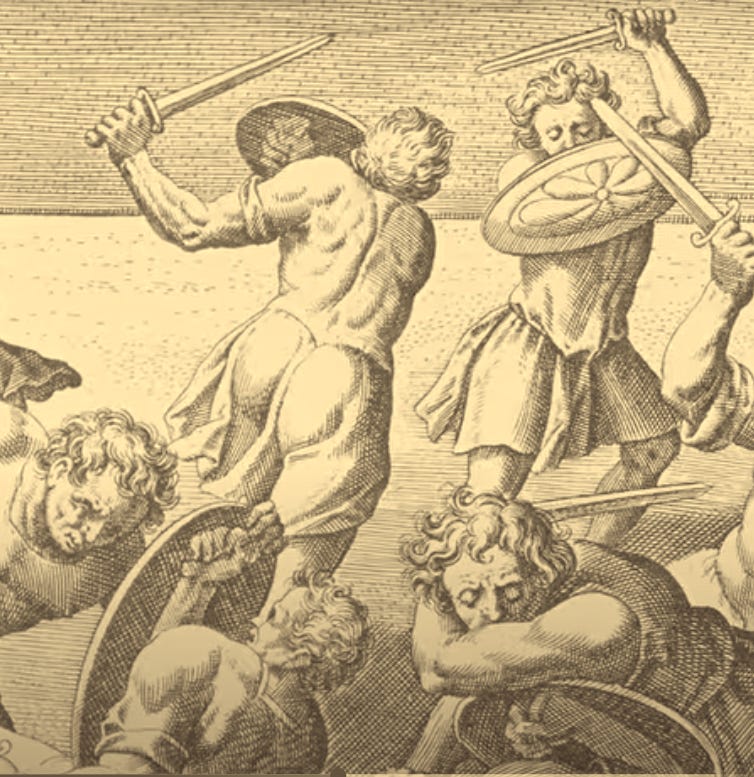
The cardinal sin of modern fitness is its willful ignorance about the fact that not all exercise is for health. But there is a subtle, unspoken and perfidious assumption that underwrites this sin: that hardship is virtue. Today, this double-idiocy reigns supreme.
Once you see Mercuriale’s (and the ancient Greeks’) distinction between legitimate, military, and athletic exercise (I wrote about it here and here) , it becomes hard to unsee how much of today’s fitness culture lives outside the pro-health category while pretending to belong. CrossFit is one example. Spartan Races make the point even more clearly.
Historically, military style training existed for a reason. In ancient Greece, if your city state was besieged, the price of defeat for every adult male was death; while slavery was in store for your wife and children. It makes so much sense to train hard when the stakes are this high and accept the risk of injury, exhaustion, and a shortened life.
Today, that kind of threat is gone for most of us. But the training remains. Obstacle races are openly modeled on military training. Crawling under wires, carrying heavy objects while exhausted, running through mud, performing tasks under time pressure. None of this is ambiguous. This is not about health. It is about proving something.
And this is where ego enters the picture. Ego and the story about being a “real man” crafted by the industry. The pointless suffering becomes virtue. A Spartan Race becomes a test of character. The language shifts from defence to self improvement while suffering becomes a proxy for meaning. Difficulty becomes evidence of value. If it hurts, you must be doing something important. That’s the story. I guess the only problem with it is that it’s not true. It’s a false belief system in which exercise designed for extraordinary circumstances is rebranded as everyday self care. Military logic becomes “mental toughness.” Athletic danger becomes “pushing your limits.” Structural risk becomes “discipline.” The harder something feels, the more virtuous it appears. The less sustainable it is, the more impressive it looks on social media.
Legitimate exercise is boring by comparison. It is quiet, reasonable, and repeatable. It’s constrained by wisdom, respects recovery, age, and context. You do not feel heroic doing Radio Taiso or Slow Jogging. But you feel great afterwards and remain capable for other things in your life.
Modern fitness culture struggles with moderation. Ego does not scale down gracefully. It does not age gracefully. You can reduce the load or the distance, but you cannot easily remove the underlying incentive to do more, faster, harder and now! The structural message is that comfort is for weaklings while wisdom and restraint are for cowards.
This doesn’t mean that hard things are meaningless. Training for hardship can be valuable. Competitions can be fun. Testing your limits can be edifying; maybe it can even give you a satori moment. But it is a mistake to pretend that these goals have anything to do with health.
When exercise meant for war or competition, is sold to us as preventative medicine and health, there will be casualties. It’s not stupidity, but a natural result of following the double-idiocy logic of the modern fitness exercise. Few people stop to question it because it requires stepping out of their current frame of reference. I can’t even imagine how hard it is. It was easier for me because I stood outside it to begin with. I’m also an anthropologist. To anyone who broke out of this matrix and reached similar conclusions, congrats. I know it could not have been easy and you might have even lost friends over it.
If you want to train like a warrior - fine. But you should at least be honest about the war you are fighting. And if your goal is a long, capable life, then most of what passes for fitness today is simply the wrong tool for the job.
The best part about emailing my thoughts to strangers receiving comments and engaging with your thoughts and experiences. So leave a comment. Now! 😜
A note on what I’m doing and why. I’m an anthropologist turned fitness contrarian and I write about how to build strength and flexibility without surrendering your life to the gym. You can support me as a member on Buy Me a Coffee. Now you will get a special perk, an early access to my course.
Huge thanks to everyone who already supports my work. I’m supremely grateful and I don’t take it for granted. Pawel
Notes
The illustration comes from Renaissance physician’s Girolamo Mercuriale’s 1569 book De Arte Gymnastica.
At 75, I am not planning to go to war, so, Pawel's program is perfect for me. I recommend highly for you too.
You make a great point how the Fitness Industrial Complex tries to sell us, lots of fomo there too! Dan John's work on the 4 quadrants gives a good picture.