


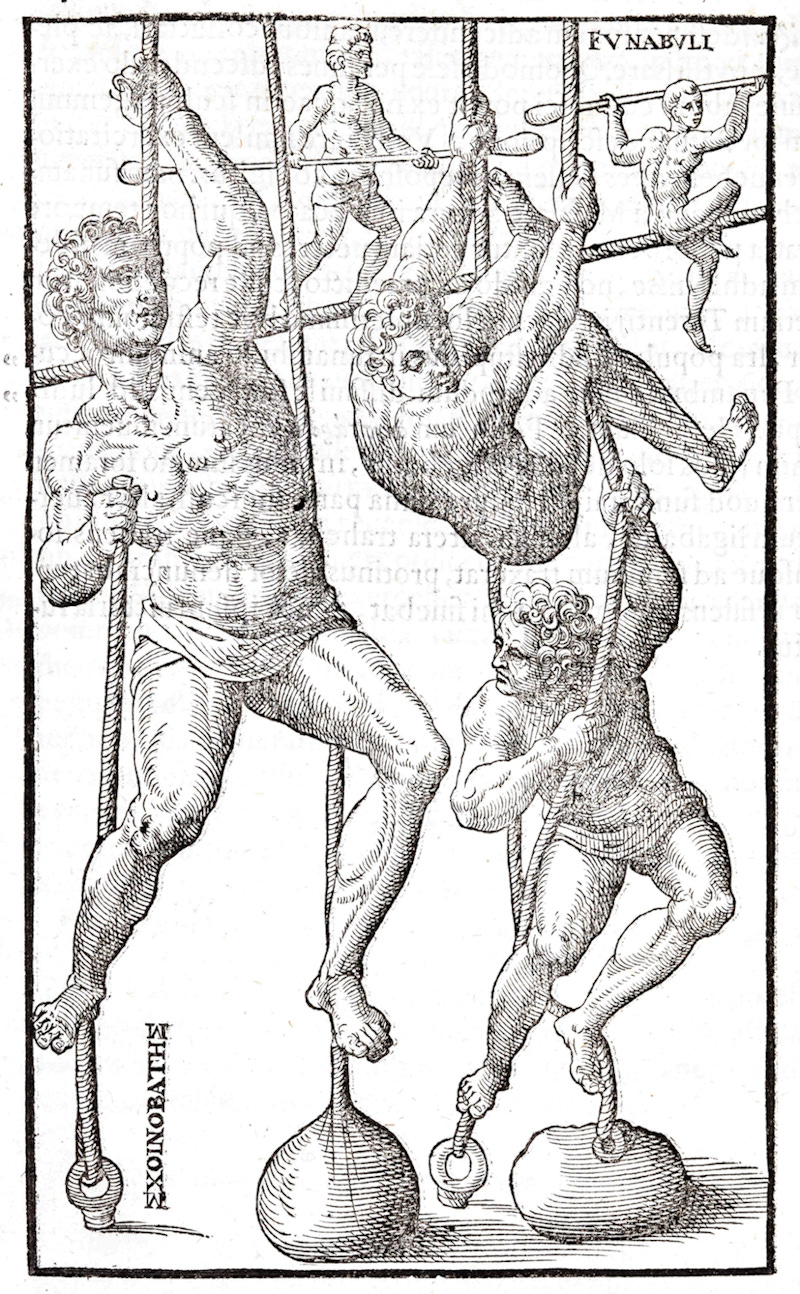
One of the earliest books on exercise and physical therapy is Girolamo Mercuriale’s 1569 De Arte Gymnastica. In it, Mercuriale revisits ancient Greek writings on physical health. From it a picture of exercise emerges not as much of a spectacle or self-punishment, but as medicine.
The Greeks understood physical training as preventative care. Exercise was there to keep the body functioning, not to test how much damage it could survive. Gymnasia were places for developing the body (and the mind!)
What makes Mercuriale’s work especially relevant today is how clearly he categorises exercise. He distinguishes between “legitimate” exercise, intended for health and medical purposes; “military” exercise, aimed at being ready for war; and “athletic and dangerous” exercise, which is competitive.
Our modern time could use with that distinction. Much of what is marketed today as “healthy” fitness would, by Mercuriale’s standards, fall squarely into the military or athletic and dangerous categories. Marathons, extreme endurance events, and high impact training are not health practices in the preventative sense. They are stress tests. Sometimes impressive, sometimes meaningful, but not neutral to, and certainly not required for, health.
Mercuriale also emphasised factors we now largely ignore: season, age, diet, and sleep. Exercise was never one size fits all, and never divorced from recovery or context. The goal was durability, not domination.
Ancient gymnasia had no machines and no lycra. If you wanted to lift something heavy, you lifted something heavy. Movement was simple, varied, and limited by reality rather than Instagram-fuelled ambition.
We do not need to copy the rules of ancient gymnasia. But we would do well to recover their clarity of purpose. Not all exercise is for health. Some of it is for war, some for sport, some for ego. Confusing those categories is how people get injured while believing they are doing themselves a favour.
Health-oriented exercise should leave you more capable tomorrow than today. When it does the opposite, it belongs in a different category.
By the way, the best part about writing in a public space is receiving comments with your thoughts and experiences. So leave a comment. And if you’d rather find out more about the things discussed in today’s post, check out the links in the Nerd Appendix.
A note on what I’m doing and why. I’m an anthropologist turned fitness contrarian and I write about how to build strength and flexibility without surrendering your life to the gym. You can support me as a member on Buy Me a Coffee you will get a special perk, access to my course.
Huge thanks to everyone who supports my work. I’m supremely grateful and I don’t take it for granted. Pawel
Nerd Appendix
If you’d like to nerd out on ancient Greece gymnasia and Mercuriale’s work, here are some useful starter links:
https://becker.wustl.edu/news/health-fitness-ancient-greece/
https://www.worldhistory.org/Gymnasium/
https://www.historytoday.com/panathenaic-way-fitness
I really like that closing statement, as I coach and teach in the 50+ community, I use variations of it often.
Great article and educational. Because the marathon run originated with the Greeks, one imagines them as the ultimate hedonists, overly concerned with how their bodies looked.
Or maybe I've confused then with present day 🤔
A younger, slim friend of ours has just, an hour ago, delivered her first baby after 30 hours of labour. Now that's an example to me of a marathon struggle for life by a normally healthy, human individual.
Thanks Pawel...