


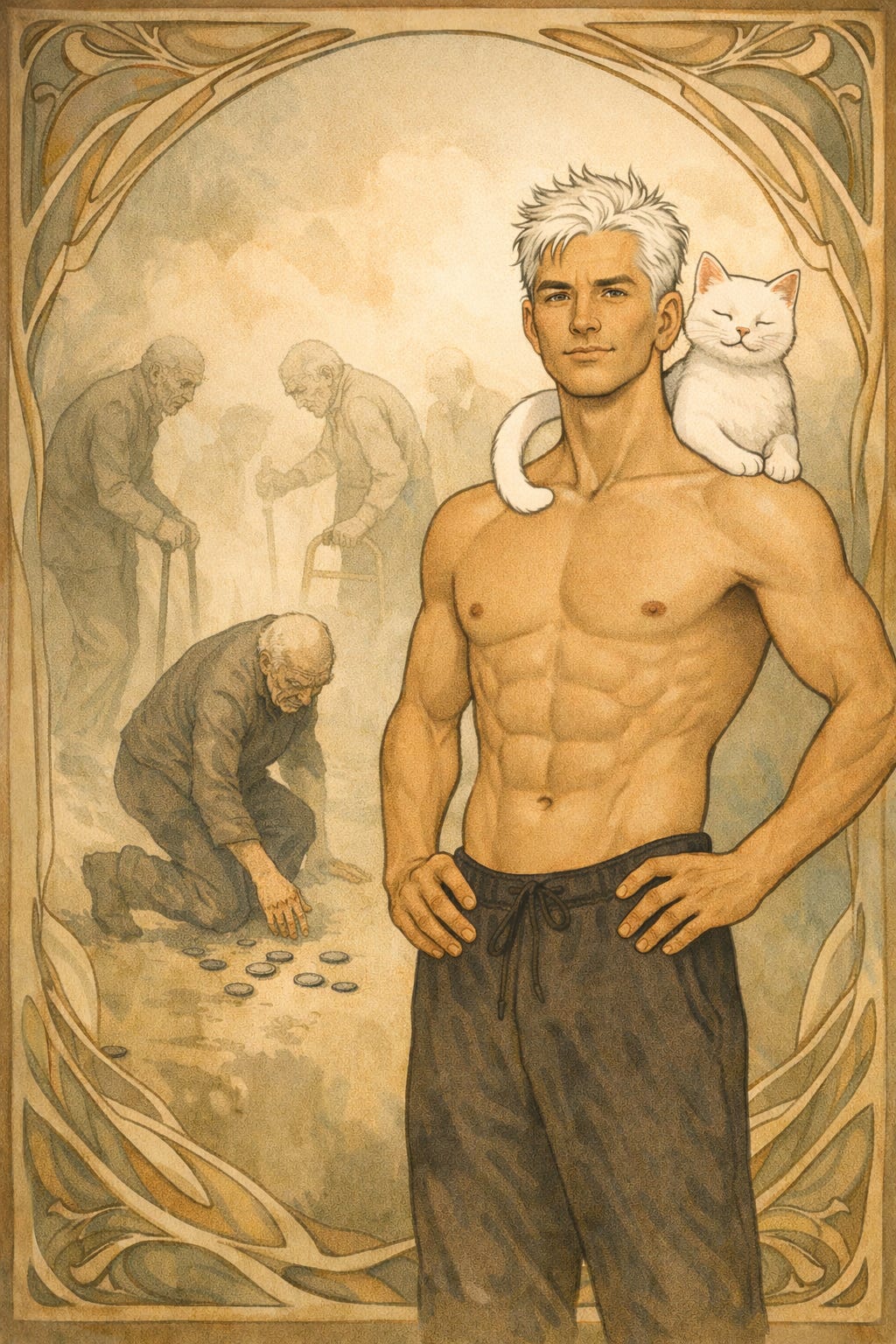
The tragedy is that we’re living through these Fitness Dark Ages and people don’t know just how much they stand to lose by not exercising, how easy it is to be fit, and just how little time it can take.
Something has been on my mind a lot lately. What is it with that whole “old and frail” phrase? Does it really have to be like this?
I don’t believe so. I believe you can be “old and robust”, “old and capable”, or better yet, “ageless and flexible”. Which one you end up as is not an accident. It is the result of countless small choices made over decades, choices you have already made and are still making. I urge you to make the right ones, while the future is still not set in stone, but soft and malleable.
The impulse to write this came from a moment that surprised me. I realised I felt anger, real anger, at a very pitiful old man.
I was slow jogging the other day when I saw him getting to his car. His walking was very stilted, every step seemed to have required planning and careful execution. When he reached into his pocket for the keys, some coins fell to the ground. He groaned. You could almost see the calculation running in his head. Bending down is going to be too much. Getting back up might be even worse.
I considered helping him, but there is a language barrier between us, and the last thing I wanted was an awkward misunderstanding where he thought I was after his coins. I jogged on, almost hearing him think, “How am I going to get down?” If I were him, judging by the way he moved, I would probably have left them alone. It simply looked like too much trouble.
That moment brought the phrase “old and frail” back into focus for me. In English, the two have fused into a single idea. We say them together, as if one naturally follows the other.
I am only in my early fifties, so you will have to check back on me in twenty, thirty, or if I am really pushing it, forty years to see whether my bet on movement pays off. Still, we do not have to speculate blindly. We already know people who are old and robust. They exist. Which means frailty is not an inevitable outcome of age itself.
I do feel sorry for people who are old and frail. Life can deal bad hands. Disease, injury, poverty, and plain bad luck are real. But in many cases, frailty is also the result of decades of neglect, of treating the body as something that will somehow take care of itself. That is where my emotions get complicated.
When I tried to untie what I was feeling, I realised it was anger. I couldn’t help but ask the old man (silently, in my head): “how could you have done this to yourself?” and I also couldn’t help but to scream (also in my head) at society at large: “You’ve engineered this!”
Our societal norms are teaching people not to move. Does it have to be that way, though? We have done remarkably well with our teeth. We teach children to brush their milky whites that will fall out anyway, just to instil in them a habit that will last a lifetime. We accept without question that if you do not brush your teeth, you will lose them.
Yet we do the opposite with bodies. We treat movement as optional. I am especially angry at the fitness industry for portraying fitness as an all or nothing pursuit, one that requires sacrifice, obsession, and surrendering your life to the gym. Faced with that false choice, most people quite reasonably choose nothing. For the longest time I chose nothing too.
We live in strange times. For most of human history, movement was unavoidable. Survival demanded it. At the same time, conserving energy was always sensible. That instinct has not gone away. Now we live surrounded by mountains of food and earning our meals by sitting motionless in front of screens, with no built-in signal telling us to move. There is no thirst for exercise the way there is thirst for water or hunger for food. So we have to do what we did with teeth. We have to make movement a conscious habit.
The good news is that it does not take much. My own daily routine, the one that keeps me strong and capable, takes under ten minutes. Not much longer than brushing your teeth twice a day. And yes, even starting late helps. Our bodies respond to training far later in life than most people realise.
People who do not brush their teeth will lose them. People who do not move stand to lose far more.
What I’m doing, and why
I am an anthropologist turned fitness YouTuber, and my work focuses on something most of the fitness world gets wrong: how to build strength and flexibility without surrendering your life to the gym, and without breaking yourself in the process.
The course I am building is shaped by long-term thinking about bodies, behaviour, and habit formation. It is designed for people who want to stay capable for decades.
Supporters on Buy Me a Coffee get access to the beta version. This is early access to the system while it is still being refined, before it is packaged and priced and released to the world at large. If this way of thinking resonates with you, this is the moment to step inside.
To those who already support my work, thank you. You are backing a different model of fitness, one that refuses to accept frailty as the default and is an alternative to the Fitness Dark Ages we’re currently living through.
This is a brilliant take on how we treat movement. The teeth analogy cuts through all the usual fitness nonsense becuase it reframes the whole thing as basic maintenence instead of an optional lifestyle choice. I've seen something similar with my dad who avoided exercise his whole life and now at 72 struggles with basic tasks that should be automatic.
This reminds me of a "picker upper" gadget my father bought when he began having difficulty bending over--basically a pair of rubber coated tongs at the end of a long stick. With controls at the handle you squeeze to operate the tongs. Maybe if he worked on flexibility he might not have needed that thing, or at least put off needing it until many years later. I remember thinking at the time that those tongs were a type of surrender.